Search This Blog

2024-11-23

Overlapping reading: Cortical and Limbic democracies

Vortex (Last book in the Spin trilogy) 

by Robert Charles Wilson (2011)


“Cortical and Limbic democracies” Ways of implementing consensus governance. Neural augmentation and community-wide Networks had made possible many different kinds of decision-making. 


In “cortical” democracies, the brain areas interfaced are clustered in the neocortex. They used noun-based and logically mediated collective reasoning to make policy decisions. 


In “Limbic” democracies the Networks modulated more primitive areas of the brain in order to create an emotional and intuitive (as opposed to a purely rational) consensus. 


“To put it crudely, in cortical democracies citizens reason together; in limbic democracies they feel together.”


Nexus: A Brief History of Information Networks from the Stone Age to A

by Yuval Noah Harari (2024)


“What I realize is that the social media companies are not incentivized to interconnect pre-frontal cortexes. Social media companies are incentivized to create interconnected limbic systems—which is much more dangerous for humanity.””

2024-01-01

Moral Luck

I want to tell you how amazing my Son is; the story won't start out sounding that way; please be patient with me; it is also a story of a father's tendency to belabor the point.

Several years ago, he was following me so I could fill up his car with gas; just before we got to the station, he rear-ended my car. Nobody was hurt, but the bumper bears the scar to this day. This story might have been a typical tale of a minor accident, but there is a deeper issue: he knew the brakes were not strong and/or failing, and he kept driving it in that condition. I saw an opportunity for some parental guidance, so I introduced the idea of Moral Luck into the telling of the accident (knowingly driving impaired and not injuring someone is just morally lucky; if you hurt or killed someone while driving impaired, you would be thought of as a monster).

For my part, I have declined to fix the rear bumper, leaving it as a conversation piece, giving me an excuse to tell the story and introduce more people to the idea of Moral Luck.
 

Over the years I doubt a month goes by without me telling this story in some way or another. Often, while my Son is present, he has repeatedly informed me that he understood my point and has even taken up the mantel to explain the idea of Moral Luck to coworkers and customers in his job as an auto mechanic. Despite this apparent parental success, I keep telling the story, believing the world is made better by sharing stories and tools for thinking, and Moral Luck is a big idea.

Here is the amazing part: The other day, we were at an appointment together, and I launched into another Moral Luck seminar. I know it makes him uncomfortable, but social progress isn't always comfortable. On the drive home, he informed me that I should stop telling this story, not because it makes him uncomfortable, but because it looks like I'm bullying my Son in public and making the other listeners uncomfortable.

I'm still processing his advice, but I wanted to capture his empathetic insight into the effect I was overlooking in my listeners, as well as his persistence in insisting that his father listen to his advice. 

2023-11-07

WiFi and Bluetooth Troubleshooting Weekend

My motto is "Mysteries are Questions, Not Answers," which is evident when troubleshooting signal interference problems.


The WiFi Mystery/Answer

I dismissed interference as an issue because we mostly had good service even though we had an old Google Nest WiFi router sitting right next to our primary cable company WiFi router. I didn't think it was a problem, and all of our lights, switches, and smart speakers were on that router, so why change it? Over the years, we did notice several dropouts of the WiFi signal from the primary router, so much so that I scheduled a job on all my MacOS and Linux machines that logged the WiFi strength every minute. I saw the signal strength drop to single digits during one sustained dropout. I unplugged the Google router, and the signal shot immediately back to max! So now I just had to visit every one of the dozens of our Internet of Things devices and reprogram the SSID. 


The unraveling of mysteries did not stop here. While reprogramming, I solved two more. One of the smart plugs was using an extension cord that only pretended to have a ground wire (which often acts to enhance the WiFi signal), so I swapped that out of a properly grounded cord, and plug was much smarter and much more reliable. The other mystery was the reading lamp smart bulb. That bulb had never worked well, and I hoped the new configuration would fix everything. It seemed to at first, but I was reprogramming all the lights in the same light socket closest to the router. When I put it back into its light socket, it didn't respond. Other lights even further away were perfect. Then it hit me: this light has a metal shade! When I tipped the lamp over and (awkwardly) pointed the cone toward the room where the router was, everything was fine. Not a good solution, but at least we know the problem.


The Bluetooth Mystery/Answer

That was Saturday. The next day, I set out to troubleshoot another bothersome issue that, again, initially wasn't a problem but had grown to be seriously annoying. I have a MacBook from work and two personal Mac Minis, all three connected to the same Bluetooth keyboard and mouse with a special button to cycle between them. This configuration has been perfect until a few weeks ago. The interface with the Mac Minis had become sticky, and the mouse was sluggish and tended to stutter. It was impossible to work with, but I never had trouble with the MacBook. Remember that this is the same physical keyboard, so it isn't sticky keys. When I moved the MacBook into the next room, everything was great. So, I rearranged the monitors and minis so that the computers were under the metal stands that supported the monitors, acting as a shield from all the interference of the MacBook. Now everything coexists nicely.


Summing Up

Creating the scheduled job to monitor the WiFi strength every minute was a massive help to troubleshooting. Logs and experiments are the best tools for troubleshooting. I have yet to find a way to get metrics on the Bluetooth, but the results from the "separate and shield" experiment strongly hint at the answer.


The WiFi and Bluetooth devices have been in the same proximity for over a year, but the problems seem to worsen over time, so there is still a little mystery. Maybe there was a software update? Maybe antennas and transceivers bleed into adjacent frequencies as they age? Keeping such equipment separate has always been a best practice anyway.


Keep looking for answers; there will always be more mysteries.

2023-08-26

I asked ChatGPT4 this totally disingenuous question:

Is it even possible to improve on this great motto: "Mysteries are Questions not Answers"

2022-04-23

Monocausotaxophilia

An interesting restatement of H. L. Mencken's often restated:

"There is always an easy solution to every complex problem--neat, plausible, and wrong."

From Kim Stanley Robinson's "The Ministry for the Future":

Monocausotaxophilia: the love of single ideas that explain everything, one of humanity’s most common cognitive errors.

2021-05-20

People are Mysteries, not Puzzles

This is the sort of thing that is obvious once you think about it, something we all know, but we tend to forget as problems crop up in our relationships with our fellow humans. More information about what isn’t working might not help, the proper way to deal with each other is still “conjecture and criticism”. This is why it is valuable to keep communications alive in all your relationships, coupled with the idea that you can question anything and you might just be able to build understanding. Not solve the mystery, just work towards being less wrong. 

Keep in mind this is about strengthening relationships between two or more people who have compatible goals and ideals. People who don’t have common goals, or even a common understanding of the world will need at a minimum a desire to understand each other.

People are not a means to an end, they are ends in themselves, this is the cause of the mystery. If all you needed to understand someone was to know everything about them, then they would have to be static puzzles with a finite number of pieces, instead of the dynamic mysteries we really are.

2011-07-07

"Lucky isn't the best you can do, it is just what happens to you"

From this morning's "Family Circus" (which is weirdly restricted online so I will not be including an image).

Mother to Billy: "ALWAYS TRY YOUR BEST." (parents seem to talk in uppercase in the strip)
Billy's response is: "Why can't I just be lucky?"

Within seconds I had a new formulation for my motto: "Lucky is better than Smart" (with its vital addendum "As long as you can stay Lucky"). Now we have the more rhythmic version:

"Lucky isn't the best you can do, it is just what happens to you." 

I can see myself using this phrase with children, but it isn't the sort of sing-song one would use with another adult.

I have a few more versions I have been kicking around recently:

"Lucky is how I live my life, but I get paid to be smart"
-or-
"Hope for good luck, plan for bad"

One part of the search for a new phrasing is that the contrast between "Lucky" and "Smart" sounds like you are calling someone dumb, and there are situations where that is not going to inspire people to be smart. The other part is trying to minimize the confusion. I often get the impression people think I am advocating "lucky" over "smart" when in fact it is the opposite (thus the addendum).

:-Dan

2010-10-12

What would you change in history?

I had one of those kid questions: "If you could change one thing in history what would it be?"

I didn't have an answer right away. As I was still thinking about it I was also listening to some debate about the nature of the bible. Then it occurred to me, if movable type was invented thousands of years earlier people would not be able to view any one book as so amazingly special. Also think of the improved literacy throughout history.

2010-07-25

Jill Bolte Taylor's story about her story-teller

This is one of those simple and somewhat obvious truths about ourselves. It is amazing to me that anyone can hold on to any religion based on the stories of other people. 

From: MY STROKE OF INSIGHT: A Brain Scientist’s Personal Journey. by Jill Bolte Taylor
Pages: 143-4

As my left brain language centers recovered and became functional again, I spent a lot of time observing how my story-teller would draw conclusions based upon minimal
information. For the longest time I found these antics of my story-teller to be rather comical. At least until I realized that my left mind full-heartedly expected the rest of my brain to believe the stories it was making up! Throughout this resurrection of my left mind’s character and skills, it has been extremely important that I retain the understanding that my left brain is doing the best job it can with the information it has to work with. I need to remember, however, that there are enormous gaps between what I know and what I think I know. I learned that I need to be very wary of my story-teller’s potential for stirring up drama and trauma.

In the same vein, as my left brain enthusiastically manufactured stories that it promoted as the truth, it had a tendency to be redundant - manifesting loops of thought patterns that reverberated through my mind, over and over again. For many of us, these loops of thought run rampant and we find ourselves habitually imagining devastating possibilities. Unfortunately, as a society, we do not teach our children that they need to tend carefully the garden of their minds. Without structure, censorship, or discipline, our thoughts run rampant on automatic. Because we have not learned how to more carefully manage what goes on inside our brains, we remain vulnerable to not only what other people think about us, but also to advertising and/or political manipulation.

I wish I was thoughtful enough, and took enough notes to do book reviews. Since mostly I listen to audiobooks while driving I cannot easily take notes. That said, I can easily recommend this book. There is a very compelling personal story, and some really good life advise in general.
She does seem to abuse the word "energy" in a very New Age way, but I found myself forgiving her usage as typical metaphor runaway.

 Note: just missed the "once a year" mark for posting on the blog.

2009-07-04

Critical thinking creeps up on little kids feet

It is hard to know if casual Dad talk ever turns into thinking critically. Sometimes they say "remember that thing you told me?" and then we can clarify or teach each other a few things.

My favorite feedback came from talking to John(7) about noises in the house. I gave the standard talk about houses heating up in the day and cooling down at night, and stairs releasing strain after you walk up them. Then to make a particularly personal point, I told him about the illusion I deal with most mornings. While I'm waiting for the water to heat up so I can shave, the pipes are expanding and pinging as they heat up. Both the running water and pipe noises combine to make me think that one of my children is sneaking up to say "Boo!" to me (as is their want). I cannot resist looking, even though it is almost never the case. Sometimes I even say "I know you are there..." to nobody.

Story over, now maybe he will stop dragging me to his room to get his PJs because he is afraid of ghosts (the practical reason for telling the story).

Next morning I'm waiting for the water to heat up so I can shave, and this time I'm sure there is a child sneaking up on me. I poke my head around the corner, and there is John grinning ear to ear. He announces "This time it WAS me!"

Sharing critical thinking can be fun :-D

:-Dan

2009-05-03

You learn to have a life

Just listened to this song a few times in a row. Still thinking. By the end am I still a child with too much to prove?


Artist: Suzanne Vega
Song: As A Child
Album: 99.9f

As a child
You have a doll
You see this doll
Sitting in her chair

You watch her face
Her knees apart
Her eyes of glass
In a secretive stare

She seems to
She seems to
She seems to
Have a life

Pick up a stick
Dig up a crack
Dirt in the street
Becomes a town

All of the people
Depend on you
Not to hurt them
Or bang the stick comes down

And they seem to
They seem to
They seem to
Have a life

As a child
You see yourself
And wonder why
You can't seem to move

Hand on the doorknob
Feel like a thing
One foot on the sidewalk
Too much to prove

And you learn to
You learn to
You learn to
Have a life

-end-

2008-12-14

Mormon Malcor?

Google Books has some amazing stuff. And it integrates really well with the Google Notebook and Blogger. I have discovered that many Malcors were also coal mine inspectors (and it lists their ages and post offices as well as the date they were certified.)

This next discovery needs more connection, "Clement" isn't a family name I'm familiar with:

Journal of History By Reorganized Church of Jesus Christ of Latter Day Saints: "organist Morgan John Smith stake president was with them November 12 to 15 By nomination of a priesthood meeting recommendation of the branch and approval of the stake authorities Clement Malcor was ordained a teacher and David J Williams a deacon January 3 1904 On December 24 the Sunday school gave a cantata entitled Santa Claus at his best netting $27.50 It was repeated the following evening for the benefit of William Erb now in the hospital at Des Moines netting $26.50 The branch has lost six members by removal"

2008-12-10

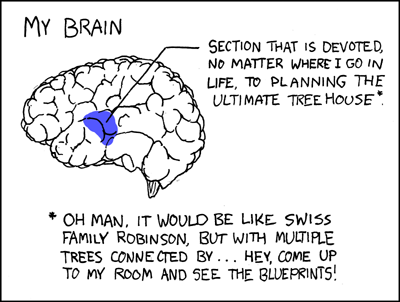
Ultimate Treehouse

Some things just ring true....


When I was a kid did have a cool tree full of wood and chairs and stuff. It was far from "Ultimate Treehouse" (that is better developed in your brain [where there is no building code]).

:-Dan

2008-07-06

Defining science

I just started reading: The Mind's I: Fantasies and Reflections on Self and Soul by Douglas R. Hofstadter and Daniel C. Dennett. It has been on the shelf for a while and really needs reading.

In the Introduction on page six we have (in my opinion) both a good and a bad use of the word "science" (it really does not matter what the surrounding text says):

Good: "It took science to discover the answer."
Bad: "Science teaches us that there are no such things as souls."

It is best to viewed science as a method, that can be used to discover answers. Once we start talking about what science teaches we are heading for trouble (and a possible accusation of scientism).

We might say that there has been no evidence for souls that the methods of science can work on. Or that science has been used to disprove every testable theory for how something like a soul might work (I'm thinking of things like Descartes' suggestion that the pineal gland was the seat of the soul).

Typing this (AKA: Thinking with my Fingers), reminds me that defining "science" is a non-trivial topic and even if I were qualified to pursue it, I would not produce anything both simple and generally agreed upon. Take this as personal preference.

:-Dan

Note: I so dislike reading the word "science" in proper case that I reworded every sentence where I started with "science", just to avoid the capital "S". Maybe I have issues :-).

2007-08-28

Understanding Evolution, the Daniel Dennett Way


From Daniel C. Dennett's:
Breaking the Spell: Religion as a Natural Phenomenon

I'm sure he does it just as well other places, it is actually kind of fun the way he drops this whole well crafted paragraph completely parenthetically at the bottom of page 120:

(Evolution it's all about processes that almost never happened. Every birth in every lineage is a potential speciation event, but speciation almost never happens, not once in a million births. Mutation in DNA almost never happens--not once in a trillion copyings-- but evolution depends on it. Take the set of infrequent accidents--things that almost never happen--and sort them into the happy accidents, the neutral accidents, and the fatal accidents; amplify the effects of the happy accidents--which happens automatically when you have replication and competition--and you get evolution.)

2007-07-10

Evolution and reverence for Scientists

The other night while I was bathing my two small children my six year old little girl start telling her five year old little brother: "we were once monkeys." I chimed in with the typical parental correction "we were never monkeys, humans share a common ancestor with monkeys." Correcting any six year old is problematic, they are on the cusp of knowing everything and corrections just get in the way. A small intellectual scuffle ensues:

Girl6: Yes we were monkeys
Daddy: Its OK sweetheart lots of adults get that wrong, it is a tricky thing
Girl6: I'm not wrong!
Daddy: Everyone is wrong sometime, nobody knows everything...
Boy5: Scientists know everything!
Daddy: (in his best sweet Daddy voice), Oh no.... The first thing scientists have to do is figure out what they don't know so they will know what to research. And then when they think they know something they write papers and books and create experiments for their friends to check and see if they got it right.

I would have gone on here, but I have noticed that bath time lectures on the philosophy of science are best if kept short. I think it settled in a bit, won't know for sure until later. Meanwhile Jimmy Neutron and his cartoon ilk keeps confusing "science" with magic and technology. Don't know where we would be without Bill Nye the science guy.

I have a constant worry that we really should be teaching the philosophy of science first, and then facts and wonder and awe at what we have been able to learn using the method later (see my previous language rant post). Sort of like teaching children to admire calligraphy and bookbinding before teaching them to read.

:-Dan

2007-07-02

Substitution phrases for "Science" and "Energy"

This is a language rant, but I hope to be concise:

Two of the most consistently abused words I see are "Science" and "Energy". I propose when you encounter these words in conversation or the media just substitute the phrases below and see if it still makes sense:

Science: "Fallible individuals interacting in an evaluating community"

Energy: "The ability to do work"

:-Dan

Note: the science substitution was pulled from an audible.com book I recently listened to:
William James, Charles Peirce, and American Pragmatism by James Campbell

Note: The energy substitution was suggested in the podcast quoted below:

From: http://skeptoid.com/episodes/4002

Energy is a measurement of some thing's ability to perform work. Given this context, when spiritualists talk about your body's energy fields, they're really saying nothing that's even remotely meaningful. Yet this kind of talk has become so pervasive in our society that the vast majority of Americans accept that energy exists as a self-contained force, floating around in glowing clouds, and can be commanded by spiritualist adepts to do just about anything.

Doubt, the Navy, and Anna Karenina


I'm always interested in the history of my doubt, and I'm usually startled to discover reminders that it has been with me a long while. I just found this quote (slightly different translation) that I had copied into a journal in 1986 while I was on my western pacific cruise on board the Truxun (note: I was the only one reading Anna Karenina, I refused to read The Hunt for Red October while I was actually in the Navy).

Anna Karenina - Chapter 8

... he had been stricken with horror, not so much of death, as of life, without any knowledge of whence, and why, and how, and what it was. The physical organization, its decay, the indestructibility of matter, the law of the conservation of energy, evolution, were the words which usurped the place of his old belief. These words and the ideas associated with them were very well for intellectual purposes. But for life they yielded nothing, and Levin felt suddenly like a man who has changed his warm fur cloak for a muslin garment, and going for the first time into the frost is immediately convinced, not by reason, but by his whole nature that he is as good as naked, and that he must infallibly perish miserably.

(that was all I copied into the journal, seems to me it gets better a few paragraphs on)

The question was summed up for him thus: "If I do not accept the answers Christianity gives to the problems of my life, what answers do I accept?" And in the whole arsenal of his convictions, so far from finding any satisfactory answers, he was utterly unable to find anything at all like an answer. He was in the position of a man seeking food in toy-shops and tool shops.

Never forget the importance of asking the right questions. Asking: "What is the Meaning of Life?" presupposes that there is something outside of you generating and attaching this meaning to your life. Isn't a better question: "What purpose shall I give to this moment, what meaning shall I give to my life?"

:-Dan

2007-04-12

Problems and Mysteries


The debate about whether God is real misses the true nature of the question. Here’s why.

By Marc Gellman

The French existentialist Gabriel Marcel in his book "The Mystery of Being" helpfully distinguished between two types of questions: problems and mysteries. Problems are questions about things outside of us that we lay siege to. When we answer them correctly they go away forever.
...
Mysteries are not questions we constitute (those are problems). Mysteries are, according to Marcel, questions within which we ourselves are constituted. Mysteries are not problems that have not yet been answered.

I think this is just word play. Historically we have often thought we were constituted of different "mysteries" that turned out to be "problems" after all. Belief in a god or the supernatural is the same sort of thing. The question isn't "Is there a God?" the proper question is "Why do we think gods (or ghosts, or ESP) are real?"

Time to start reading Dan Dennett's:
Breaking the Spell: Religion as a Natural Phenomenon

:-Dan